I've spent the last couple of hours trying to collate the information I need to finish a post I'd like to write.
Except that I haven't found what I was looking for, instead I've found a whole bunch of really interesting stuff that only hangs together by the fact that I stumbled across it all one autumnal evening.
So to share all this with you, I'm going to bundle it all up in a little package called 'The Story Of A Blog Post'.
On Saturday we went to see Thomas.
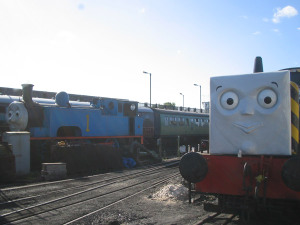
It was brilliant, of course, really good fun and exactly the kind of thing you should be doing at the weekend.
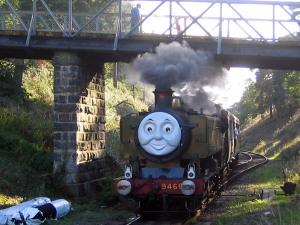
And because I have the graphic design disease (more about that later) I kept spotting things like this:


Which reminded me of several things. How brilliant British information design is and was.

How nice it is when people bother to lovingly paint type and how nice some of the British Rail graphics used to be. This got me thinking about the British Rail train identification system that won loads of awards and they always used to go on about when I was at college. It looked like this:

I remember that it came in a big, big corporate identity manual in the days when big, big corporate identity manuals were de rigour. And because I've also got the blogging disease I instantly thought, 'ah ha blog post!' Hence my quest to find more information about this graphic information system.
First off I found this:
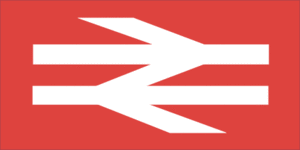
Which was designed by Design Research Unit who started trading in 1943 and in 2004 merged with Scott Brownrigg. That's a hell of a long time for a design company to be around. Most of them go to the wall within 3 years. DRU also designed a generic wayfinding signage manual for train stations in 2000, which in turn is remarkable as they were also asked to do one in the 60's.
I've always really liked this symbol. It's graphic, simple, elegant. It's got movement, it has two arrows, it looks like train tracks. It does the job of a logo well. No complaints.
Which of these is the correct version?
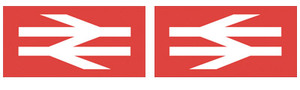
It's the first one. The top arrow points left because trains always keep to the left.
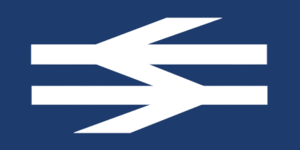
On the logo for Sealink the symbol is reversed because it looks like an S. Interesting eh?
Next up I stumbled across this:
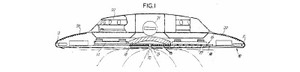
Did you know that in the 1970's British Rail actually designed and patented a design for a flying saucer?
The flying saucer originally started as a proposal for a raiseable platform. However, the project was revised and edited, and by the time the patent was filed had become a large passenger craft for interplanetary travel. It was to be nuclear fusion powered, utilising laser beams to produce pulses of nuclear energy in a generator in the centre of the craft. Pardon my language, but how fucking brilliant is that? You don't get that under privatisation.
Then I rediscovered Jock Kinneir & Margaret Calvert. Two brilliant designers who designed the current signage on Britain's roads in the mid 60s.
At the start of the 60s, determined to illustrate the haphazard state of British road signage a chap called Herbert Spencer drove from central London to the recently opened Heathrow London Airport and photographed each of the road signs that he came across along the way.
He then published the result in two photographic essays in a magazine called Typographica. This provoked the government to redesign the system. It ain't that simple these days.

(Picture taken from Gaetan Lee with huge thanks, usual stuff applies.)
The British system is now copied round the world as was pointed out to me the other week by a colleague who's just returned from Dubai.

(Picture taken from Greg Valiquette with huge thanks, usual stuff applies. Greg isn't my colleague by the way.)
Next up this random list of links about design.
Just hundreds of interesting design links.
Then the web took me on a visit to the National Rail Museum in York. I've been there in real life to talk about a project that sadly never happened. It's an absolute treasure of graphics, posters and signs. They even have a real sign for Platform 9 3/4.

(Picture taken from Neil T with huge thanks, usual stuff applies.)
It's better than this one.

(Picture taken from Steve and Brooke with huge thanks, usual stuff applies.)
Although that one is brilliant too.
Look at this stuff.
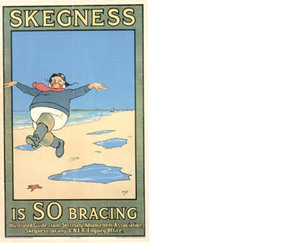
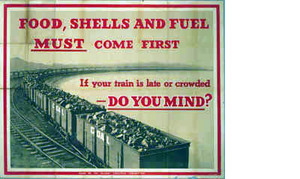

Isn't it brilliant? Even this is good.
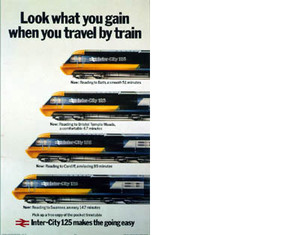
Last and by no means least I found this.

A typographic walk through London by Phil Baines.


I must do one of those myself, one day.
Still no info about the British Rail train identification system that won loads of awards and they always used to go on about when I was at college, but isn't the web the best thing ever?


Recent Comments