This is something I've been thinking about for a while. I've been discussing it with a few people including Russell, who deserves equal credit for spotting this trend and for helping me formulate this post.
I think I first mentioned Design Is The New Management Consultancy in my post about The Future Of Graphic Design. It seemed to strike a chord with most of you and was picked up by Michael Bierut on Design Observer.
(By the way Design Observer has got a lot, lot better since that redesign).
I keep reading things that elude to this theory, but nothing that's explicitly concentrated on it. So here goes. Deep breath.
Why is Design Is The New Management Consultancy?
Because true design thinking means that design is a verb and not a noun. It's a better way of thinking and not a production process that's applied at the end of a project.
Design is so much more valuable when it's brought in at the start of a project or the start of a problem. As Clive Grinyer (director of Orange's Design & Usability Innovation team) says in his current RSA Journal article, "Design is habitually brought in too late, used simply to paint and decorate products for which the major decisions have already been made. Thus we have products that are easy to build, designed by technically minded people, but that are not desirable or usable."
How is Design The New Management Consultancy?
Think back to the 50's. If you were bright, intelligent, had a slight eye for the unusual and wanted to earn decent money you went to work for an ad agency. The CDP's of this world. Nowadays you work for one of the big consulting companies, PwC, KPMG, Deloitte or Accenture. Discard your prejudice management consultants and what this means that these places are full of bright, entrepreneurial thinkers. Think about it. When Tony Blair wants to "reform" something his first thought is to call in one of the big four. It's the same with most of the PLC's in Britain. I'm not proposing that Tony Blair rings Interbrand and asks them how to reform the NHS, but what I am saying is that designers are natural problem solvers and a new type of design (and designer) is emerging from the dark days of DTP.
Post DTP and post Brand (as Trade Marked by Wolff Olins) designers have turned to innovation and strategy as a new revenue stream. Some design firms are brilliant at this, IDEO and Imagination spring to mind, whereas some are bad like Interbrand and pretty much every packaging design firm.
A good designer / client relationship will already have an element of Design Is The New Management Consultancy, they just won't know call it that. I'm talking about those moments when a design company suggests things that don't involve a specific below the line outcome. For example we were recently asked how to increase attendance at some employee feedback events. We suggested holding them at 4pm instead of 5.30pm so that employees felt they were getting some extra 'time off'. Really simple and it worked well. This is a small example of what I'm talking about.
Here's another, much more brilliant, one. I posted this a while ago but it's worth revisiting.
John Sorrell (who founded Newell & Sorrell) runs a thing called the Sorrell Foundation. They worked on a project called Joined Up Design For Schools and now they're working on one called Joined Up Design For Health. Take a look at some of their initial research.
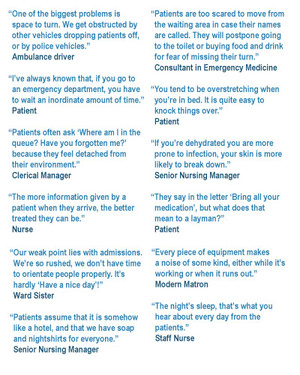
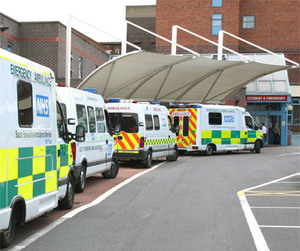
An ambulance driver said, "One of the biggest problems is space to turn. We get obstructed by other vehicles dropping patients off, or by police vehicles." So a designer in his role as management consultant could design a bigger turning area, the ambulances wouldn't get obstructed and lives might be saved. Sure, anyone could have made that suggestion after talking to that driver, but what I'm saying is that a designer is much more likely to think like that than an Accenture employee.
It's really hard to write this post as I see so many examples of this but they're all really hard to collate. I'll start a new category and try and add them as I go along. Here's another one.
I stayed in this hotel last week, here's a picture of the lift.
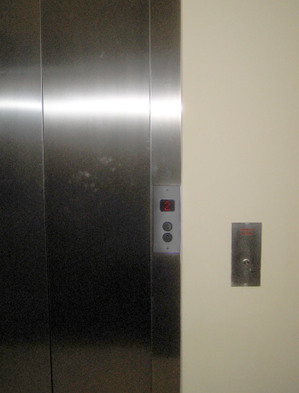
The button on the far right is actually the 'emergency alarm' button, although in real life it looks very much like the 'call lift' button. I almost set the alarm off every time I went in the lift and I'm sure it must have been set off loads of times before. This kind of stuff will be affecting their business and yet good design and good usability could solve the problem.
Here's another slightly obscure example. We worked on a project once with a massive catering firm. The managing director of this firm was a dynamic, inspiring lady whose proudest moment was that she'd changed the recipe for sausages in the Little Chef and managed to shave 1p off the cost of the sausage. This saved Little Chef millions and millions of pounds every year, and she reckoned the sasuages tasted better too. That's not design related, but can you see how designers could contribute in a similar way? By changing the way customers move around a supermarket or by changing the way the door of the AA van opens or by making more space for the ambulances to turn around.
Here's another example. Wayne Hemingway famously acted as design consultant for the Straiths South Bank housing development in Gateshead. A bold move by the developers. If you every hear Wayne talk (and boy he can talk) he gets really animated about this project. One of the things they wanted to do was to bring back the idea of communities, neighbours that actually know each other. Yeah, yeah, yeah, you'll be thinking, every house builder says that. Wayne (a designer by the way) identified that one of the big problems was that parents were afraid to let their kids play outside because they couldn't see them from their lounge windows. The reason they couldn't see them from their lounge windows was because their cars were packed right outside their house. The reason their cars were parked outside their houses was because they were worried about them getting nicked.
George Wimpey had discovered that if they built homes where you couldn't see the car from the window people were less inclined to buy. Really. All subliminal stuff that people would never mention in a focus group, but true none the less. So, driveways in front of houses meant no gardens and therefore nowhere for kids to play where parents could easily keep an eye on them, therefore kids played inside or in the back garden, which meant less social interaction (if you've got kids you'll know what a brilliant conversation opener they are) and no community.
Solution? They designed homes with a garden right outside the front windows. Cars were put in a secure underground car park under the estate, so parents could stop worrying about their cars and keep an eye on the kids. I might be a little bit wrong on this bit because I'm trying to remember a talk from a few years ago, but you get the point.
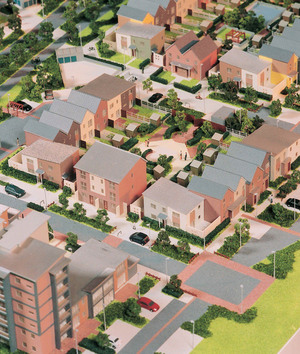
That sounds so simple, doesn't it?
Here's yet another one. I was in a van the other day. A Volkswagen van. In the top corner of the windscreen, drivers side, they had a little sticker that told you what oil the van took.
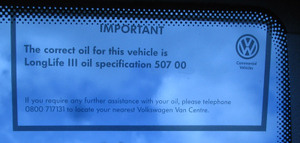
Isn't that a brilliant idea? They ought to put more useful info on there, like tyre pressures (I always forget tyre pressures) and service intervals and stuff.
Am I making sense? There are already designers doing all this and there are already people talking about this kind of thing. I think this is going to be huge in the coming years and the good designers, the successful designers will have to start thinking like this.
What does everyone else think?


Recent Comments